
Operational Change, Measurable Results
A Retail-Focused Case Study in Distribution PerformanceOperational Context
Implemented Changes
A structured improvement approach was applied with a focus on reliable execution, scalability, and repeatability. Key initiatives included:
- Facility and network modeling to support store-level order profiles
- Workflow and value stream mapping to reduce handling touches and exceptions
- Layout optimization and inventory right-sizing to improve pick access and flow
- Labor analysis and engineered work standards to stabilize throughput
- Transportation and trailer utilization planning to improve load quality and delivery efficiency
- Root cause analysis and process re-engineering to reduce damage and shipment errors
Standard work and lean principles were implemented to support consistent execution during steady-state operations, promotional peaks and demand surges.
Performance Outcomes
Order Accuracy & Store Readiness
Improvements to layout design, workflow modeling, and labor alignment delivered significant gains in order accuracy—reducing retailer chargebacks, store-level exceptions, and service disruptions. These improvements reduced downstream reconciliation effort and improved store delivery confidence.
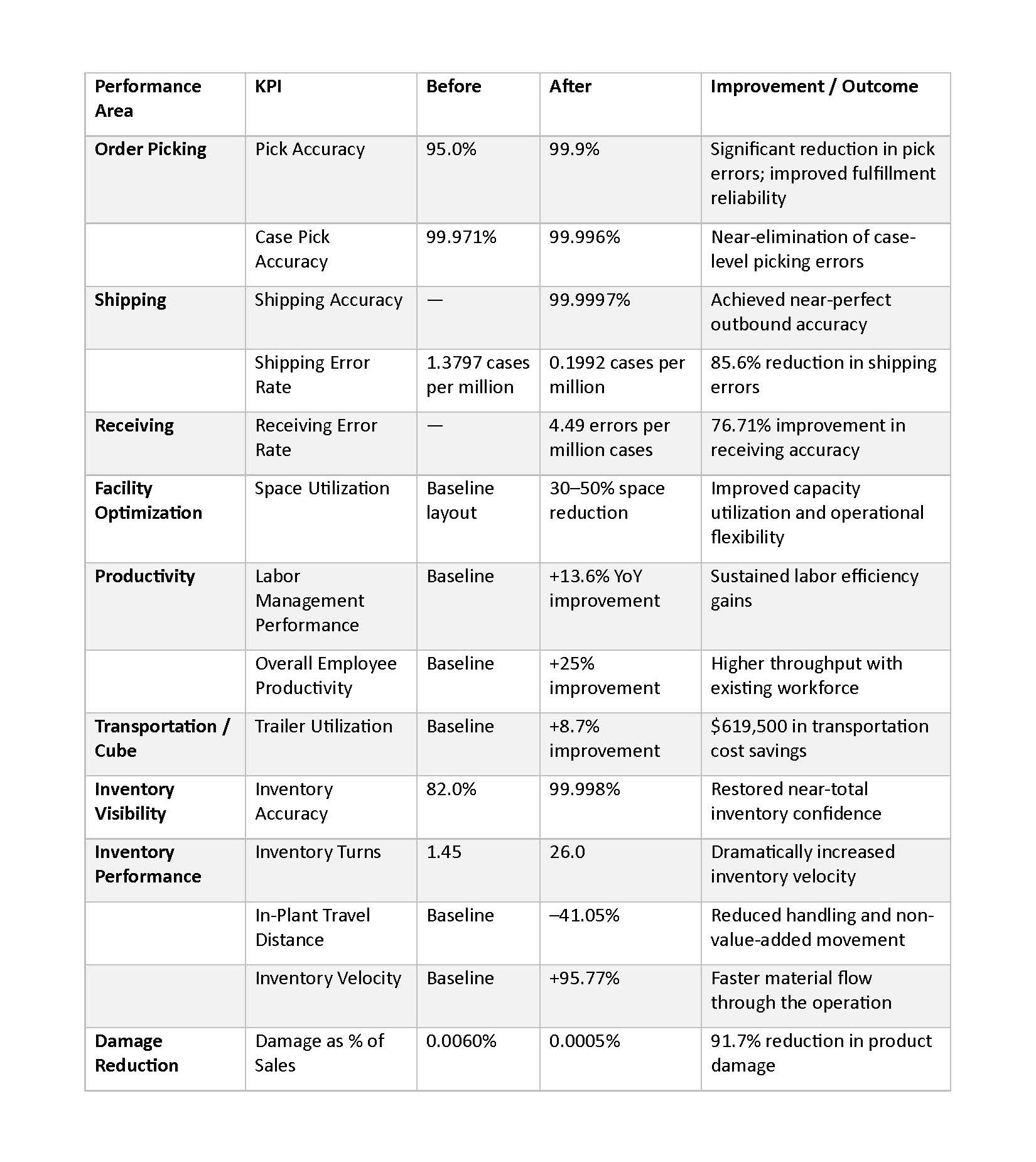
- Order picking accuracy improved from 95.0% to 99.9%
- Case pick accuracy increased from 99.971% to 99.996%
- Shipping accuracy achieved 99.9997%
- Shipping errors reduced by 85.6%, from 1.3797 to 0.1992 cases per million
Receiving & Inventory Accuracy
Standardized inbound workflows, best-practice implementation, and transportation modeling significantly improved inventory accuracy and availability. This improvement in inventory management provided retailers with accurate data to support replenishment planning and allocation decisions.
- Receiving accuracy improved by 76.71%, reducing errors to 4.49 per million cases
- Inventory accuracy improved from 82.0% to 99.998%
Space Utilization & Throughput
Layout optimization, factory flow analysis, and inventory right-sizing improved space efficiency and throughput—supporting higher order volumes without proportional cost increases.
- 30–50% reduction in space utilization
- Improved flow reduced congestion and staging constraints during peak periods
Labor Productivity & Execution Consistency
Labor modeling, engineered work standards, and lean planning improved productivity while stabilizing execution across shifts. These gains supported more efficient use of resources to produce consistent service levels during promotional spikes and seasonal demand.
- 13.6% year-over-year improvement in labor management performance
- 25% increase in overall employee productivity
Inventory Performance & Velocity
Network optimization and value stream mapping significantly improved inventory health and flow—key drivers of higher profitability and increased customer satisfaction.
- In-plant travel distance reduced by 41.05%
- Inventory velocity increased by 95.77%
- Inventory turns increased from 1.45 to 26.0
Transportation Efficiency
Network analysis, trailer layout planning, and cube utilization modeling improved load quality and delivery efficiency, reducing transportation cost while maintaining service levels.
- Trailer utilization improved by 8.7%
- $619,500 in transportation cost savings
Damage Reduction & Exception Control
Root cause analysis, layout restructuring, and process re-engineering significantly reduced product damage and store-level exceptions, reducing returns and increasing customer satisfaction.
Damage as a percentage of sales reduced from 0.0060% to 0.0005%, a 91.7% reduction
Key Takeaways for Retail Leaders
Operational Performance Improvements