
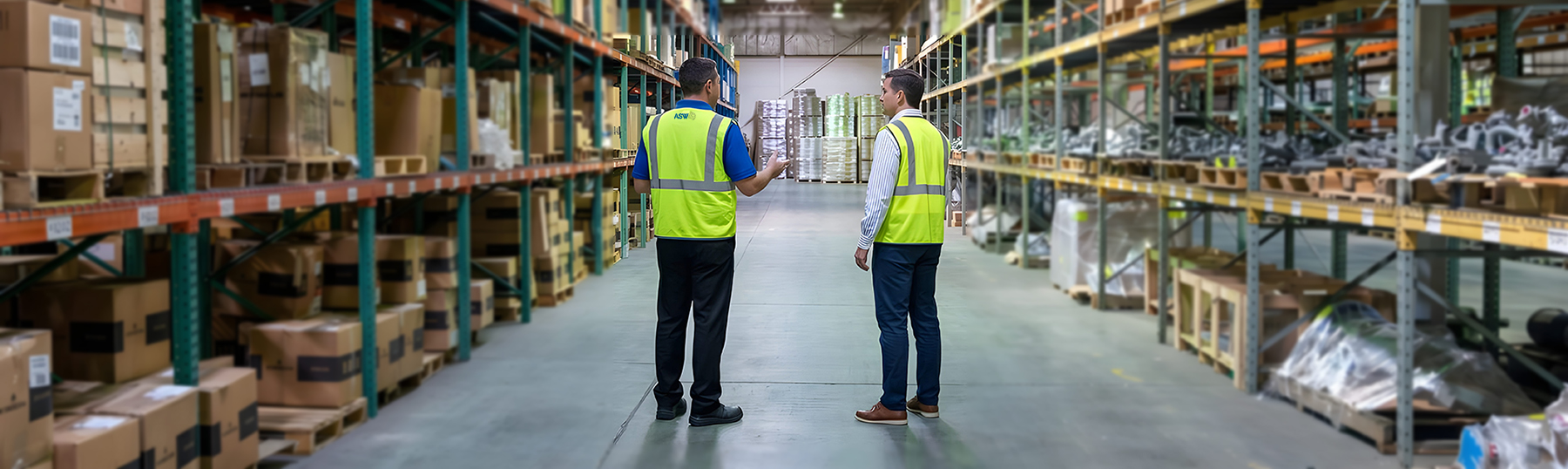
Not every warehousing provider is built for industrial operations. Manufacturers and industrial companies bring a different set of demands than other types of companies seeking storage. These include larger freight, intricate components, tighter production timelines, complex customer-specific requirements, and inventory that has to move with precision. Choosing a partner without the right capabilities can create problems that are costly to fix. Here are key things to look for when evaluating an industrial warehousing partner.
1. Experience with Industrial Customers
Industrial warehousing has different specifications and requirements than consumer goods storage. Manufacturers and industrial companies deal with raw materials, varying order sizes, project-based needs, and customer specifications that shift with production timelines. A qualified partner should understand those realities.
Tip: Look for a 3PL with a solid track record of supporting manufacturers, distributors, building material companies, utilities, chemical companies, or other industrial businesses. A partner with that experience is able to anticipate needs and provide practical solutions before minor issues become operational problems.
2. The Ability to Match Space to the Product
A good industrial warehouse partner should understand what is being stored and configure space accordingly. The size, weight, packaging, order frequency, and turnover of a product all influence how space should be configured.
Tip: The right partner will discuss building a storage solution around the product profile. Their approach will be to avoid wasted space and unnecessary handling while optimizing fulfillment speed and minimizing costs.
3. Capacity to Scale
Manufacturing demand fluctuates. Inventory levels can rise due to production increases, seasonal demand, new contracts, or delayed shipments and quickly fall during slow periods.
Tip: A strong warehousing partner should be able to support changing volume without locking your company into a rigid space commitment. That flexibility lets manufacturers respond to business conditions without taking on the cost or risk of permanent additional space.
4. Reliable Inventory Management
Manufacturers need confidence that product is being received correctly, tracked accurately, and shipped according to instruction. Clear inventory management directly supports production planning, customer service, purchasing decisions, and distribution performance.
Tip: When evaluating a partner, ask specifically how inventory is received, identified, tracked, reported, and reconciled because a warehouse management system is only as effective as the processes behind it.
5. Transportation Management Support
For manufacturers, delays in freight movement can affect customers, job sites, production schedules, and inventory availability. This makes the connection between warehousing and transportation especially consequential.
Tip: A capable partner should be proficient in inbound receiving, outbound shipping, LTL, truckload, and carrier coordination. If transportation brokerage or freight support is available through the same partner, it simplifies communication and reduces the coordination burden on your internal team.
6. Clear Communication
Warehouse partners should be easy to work with. They should provide a clear point of contact, timely updates, accurate information, and a shared understanding of expectations. You should not have to chase down answers about inventory status, shipments, receiving activity, or space availability. Slow or unclear communication creates the most operational risk during on-boarding, peak periods, and urgent customer requests.
Tip: Ask potential partners for references and then contact some of them to hear firsthand about their responsiveness and the quality and timeliness of their communication.
7. Strategic Location That Supports Your Supply Chain
Warehouse location is a significant decision, affected by both transportation costs and the need to move product efficiently. The right location depends on what the warehouse needs to accomplish. Some manufacturers need a facility close to their plant for overflow support or temporary storage prior to final production. Others need a location that improves access to customer markets via major highways, rail, or regional distribution lanes.
Tip: Consider a warehouse location based on the needs of your supply chain such as: supplier vicinity; need for final production, assembly, or customization; whether or not goods are perishable; weight of raw materials versus finished goods; customer proximity.
8. Flexible Terms
Industrial warehousing needs can change quickly, and rigid commitments can become a liability. Flexible terms reduce risk especially when demand is uncertain, a new product line is launching, or production volume is in transition.
Tip: Before choosing a partner, ask how space is priced, whether minimums apply, how easily capacity can be adjusted, and what services are included or billed separately.
Choosing the Right Fit
The best industrial warehousing partner is not the largest provider or the nearest building with open space. It's the partner that understands your products, your timing, your customers, and your operational goals well enough to be a practical, reliable extension of your business.
If you want to learn more about our warehousing services for the industrial sector, reach out to our team.